
About Economic Nutrition
Economic NutritionCM offers visibility beyond price in a purchase decision. Modelled after food nutrition labels, the certification mark shows where the money goes and what it pays for – empowering buyers and sellers to better understand the economic impact of purchase decisions.
The start of something bigger in Canada’s capital city
Community businesses have historically led the way when it comes to buying local. In a community business model, decisions are made to benefit, not extract from, the place within which the business exists. Across Canada today, businesses of all shapes and sizes are shifting their models to better adapt to changing economic conditions, while prioritizing their local community. With over 40 businesses countrywide currently undergoing Economic Nutrition certification, we’re seeing the momentum building. More businesses want to demonstrate their values in a tangible way and show their commitment to building a stronger local economy. In Ottawa, Ontario, Thyme & Again Creative Catering & Take Home Food Shop saw the Economic Nutrition label as an opportunity to bring their values into the conversation – and took the step toward showing their community where the money goes.
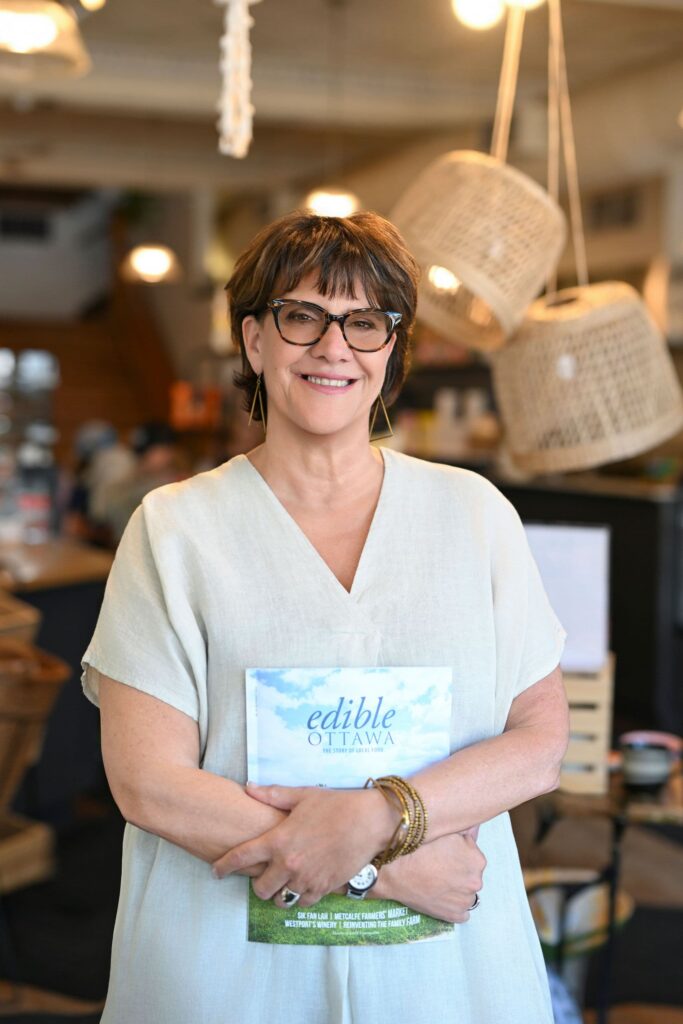
Sheila Whyte opened Thyme & Again in Ottawa in 1991. They started with just 3 employees. Thirty-five years later, the business has a full event catering company and two bustling neighbourhood shops. They have over 65 employees who work to bring the community together over thoughtfully prepared, delicious food. And now, they’re the first business in Ottawa to become Economic Nutrition certified. This isn’t just a milestone for Thyme & Again. It’s a milestone for Canada’s capital city, showing what is possible for businesses and organizations across the country.
Why Economic Nutrition?
Part of the answer for Thyme & Again starts on Fogo Island, Newfoundland and Labrador. Zita Cobb, Founder and CEO of Shorefast and the Shorefast Institute for Place-Based Economies, invited Thyme & Again to carry Fogo Island cod in their catering events in 2017, eventually adding it to their retail offering in both locations. When Sheila learned about the approach to economic development and stewardship that was happening on Fogo Island, her interest was piqued (beyond the delicious fish). It eventually led her to visit Fogo Island, where she heard Zita speak and saw the Economic Nutrition label for the first time. “I was just taken [with] what a brilliant idea it was,” she said.
The rest of the answer is based on something simple: values alignment. Since day one, Thyme & Again has been intentional about every decision they make. They handed out cloth bags from the day they opened, a decade before cloth bags became mainstream as a replacement for plastic bags. Sheila says staying true to her values has made it easier to adapt as trends come and go. When the chance to become Economic Nutrition certified came up, it was an easy yes. The entrepreneurial mindset that had pushed her to give her business a chance in 1991 – coupled with a keen interest in the growing momentum behind Economic Nutrition – convinced Sheila to take the next step.

What the label shows
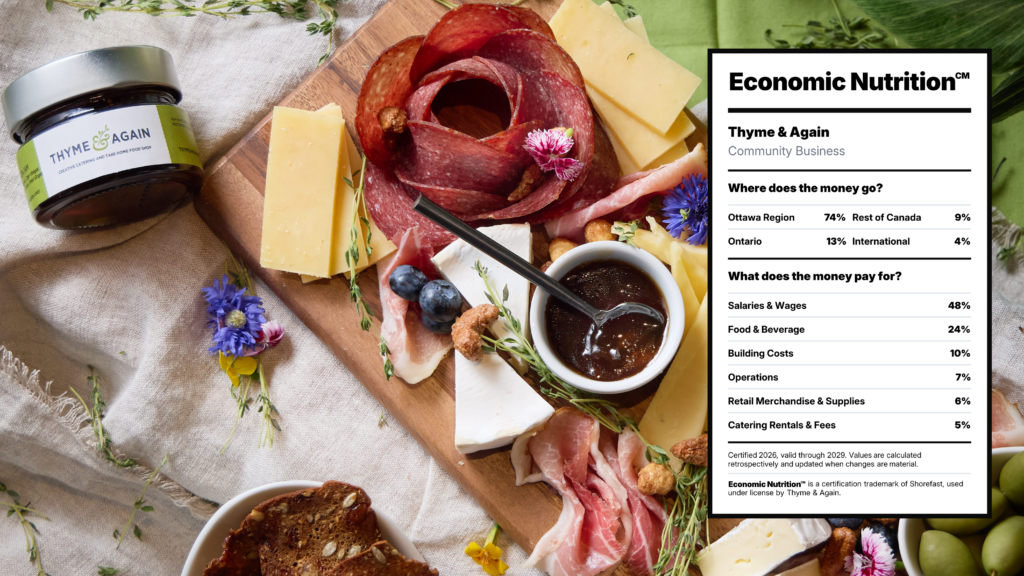
Sheila expected to find through the Economic Nutrition certification process that more of their procurement spending was leaving the country, despite her best efforts to procure locally wherever possible. But the certification process revealed something interesting: It showed their local spend was significantly higher than anticipated. It showed that over 70% of Thyme & Again’s expenditures benefit the Ottawa and Gatineau region. Another 13% stays in Ontario and 9% goes elsewhere in Canada, with only 4% leaving the country.
That result is exactly what she wants her customers and community to see. “I would like them to know where their money is being spent – and that we are spending it in Canada [and] we’re spending it in our community.”
Local is just one ingredient
While Thyme & Again’s Economic Nutrition certification and the launch of their label is a marker reflecting decades of work, it has also pushed Sheila to reflect on the questions the label brings up. Local procurement is one part of the story she’s beginning to tell – but she’s started to think about her business as a full circle. Questions like, “Where does the food come from?” are answered by the label: it shows where their sourcing is concentrated, and where that spend goes geographically. Sheila has always championed local sourcing through her relationships with local farmers, including her early work with Savour Ottawa and Feast of Fields, which paired farms with restaurants. “It’s about building relationships with the people who grow our food and understanding why they do what they do, and how it strengthens our local economy.”
But she’s become increasingly interested in questions like “What is being done with [the leftover food]? Where does it go?” Surplus food from Thyme & Again’s catering and shops now goes to Brittania Woods Food Cupboard, Cornerstone for Women, the Ottawa Mission Food Service Program and Parkdale Food Center.
“We’re in the capital of Canada and the food insecurity issue is growing every day. I feel we can all make a difference to change this.”
Having an Economic Nutrition label helps their customers, clients, and partners understand their commitment to making the economic flows of money visible; but it also is a conversation starter and a way to start exploring new ideas of how they can support their neighbours in the community. Sheila hopes to see more businesses in Ottawa following their lead.

What other businesses can borrow from Thyme & Again
- Know where your money goes. Mapping your spending shows you where you stand and where you can push further. Sheila wants to encourage her Canadian suppliers to carry more Canadian-made goods. “It provides you with an opportunity to pivot and change.”
- Let your values lead. When values guide your decisions, your label will show it. An Economic Nutrition label demonstrates what you prioritize, and how it strengthens your local community and the country as a whole.
- Bring your team into the process. Make sure your staff and teams understand the why behind your choices, so they can share it with customers and clients. Thyme & Again hosted a session with their team to work together on how they communicate about their Economic Nutrition label.
The real value: connection to like-minded businesses and a stronger Canada
The label is one component of the full Economic Nutrition Certification Program. It is the most visible, and the anchor for conversations – but it isn’t even the part Sheila is most excited about. “I’m interested in seeing this program grow across Canada and watching different businesses being able to get together and share what they’re finding.” As the first Economic Nutrition certified business in Canada’s capital city, the impacts reach far beyond local. Thyme & Again is hoping for a stronger country by bringing businesses together around shared priorities and values. “How do we continue to make Canada stronger? [The Economic Nutrition Program] is certainly one way of doing so,” says Sheila. “It opens more conversations, more dialogue, more collaboration… more of a holistic approach to running a business and making Canada, and each community, stronger.”
Start your journey with Economic Nutrition – We're in your region.
Economic Nutrition is growing across Canada through regional hubs that tailor our national program to local contexts. The next cohort starts in March 2027 and is open to businesses across Canada. If you’re on the fence, Sheila’s advice is simple: “Call me. I would just say, do it.”
To become certified or help bring Economic Nutrition to your region, visit www.economicnutrition.org.
Read more
by the
Shorefast Institute

Shorenet Stories: Greater Victoria and the Practice of Place at Every Scale

Money in Place: Newmarket’s Journey with The Shorefast Institute

Shorenet Stories: Prince Edward County

Community Reinvestment: The Golden Mile Finds Inspiration on Fogo Island

Alaina Lockhart’s journey with Shorefast


